Alex
Schneider
I study multi-modal feature fusion for scalable HPC performance modeling, from GPU kernels to cross-domain validation.
Advised by Dr. Apan Qasem
Proposal defense: Nov 2026 / Final defense: Summer 2027
Research
My dissertation, Multi-Modal Feature Fusion for Scalable HPC Performance Modeling: From GPU Kernels to Cross-Domain Validation, asks how fundamentally different information sources should be combined to predict GPU metrics like power, execution time, and cache behavior. Those sources include static code properties from PTX/SASS assembly, dynamic hardware counters captured at runtime, and graph-structural properties of input data. The way those modalities are fused shapes both accuracy and interpretability.
The work develops this thesis through GPU/HPC performance prediction, then validates that the same architectural principles hold across very different domains: large-scale multi-agent reinforcement learning, multi-modal computer vision, and bridge experiments that carry those lessons back to HPC.
Multi-Modal Fusion Baseline
A controlled comparison of nine fusion methods across two datasets finds simple concatenation stays competitive, and that per-modality encoders destroy 35 to 71% of cross-modal interactions. Extended by a four-predictor swap study (XGBoost, MLP, TabM, TabPFN) that tests where those conclusions hold and surfaces a divergence between SHAP attribution and leave-one-out importance.
Published · IEEE COMPSAC 2026Cross-Architecture PMC Characterization
Examines a circularity concern at the heart of counter-based prediction: when a model is trained on measurements produced by the very executions it aims to predict, does it learn something real about the program-hardware interaction, or only a tautology?
In progressLLM-Derived Code Representations
Investigates whether a learned representation of program code, richer than hand-crafted features, can better capture how code structure maps to hardware behavior when introduced as a new modality in the fusion framework.
In progressCode Representation Comparison
Compares several strategies for representing program code within the fusion framework, directly testing the central thesis: does strengthening the weakest contributing modality change the fusion outcome?
In progressHierarchical Multi-Agent Coordination
Asks whether the decomposition principle behind the GPU fusion work generalizes to large-scale multi-agent reinforcement learning, and how structured, bounded-scope coordination behaves at scales where flat approaches break down.
Under reviewCross-Domain Validation in Computer Vision
Tests whether the fusion framework's conclusions carry over to computer-vision and vision-language tasks, probing the conditions under which learned fusion provides an advantage over simple concatenation.
CompleteBridge Experiments
Carries the architectural lessons from the other domains back into GPU performance modeling through a set of targeted bridge experiments.
In designGRAFT (GPU Research and Analysis Framework for Testing) is a portable, multi-source collection of ~300 GPU kernels drawn from nine benchmark suites (CUDA Samples, Rodinia, HeCBench, Parboil, SHOC, CUTLASS, the Indigo graph suite, PolyBench/GPU, and synthetic generators), with standardized build, Nsight Compute profiling, and LLM-evaluation tooling. Profiles are stored as Parquet with zstd compression (~88× over raw CSV), and the local LLM inference stack runs fully offline on llama.cpp with CUDA. Code and results are slated for public release alongside publication.
Publications
2026 · SETA
● published
Does Semantic Heterogeneity Matter? Investigating Multi-Modal Feature Fusion for HPC Performance Modeling
Alex Ford Schneider, Apan Qasem
A controlled comparison of nine fusion methods, ranging from simple concatenation to attention-based and gated neural approaches, across two HPC datasets with contrasting semantic characteristics: F-DATA from the Fugaku supercomputer and GRAFT. Across 3,395 experiments, early fusion stays competitive: late fusion improves by only 4.6% on GRAFT and 6.8% on F-DATA, the opposite of the hypothesis. Encoder diagnostics show that 86% of the model's interaction strength is cross-modal and that per-modality encoders destroy 35 to 71% of it. The evidence points to feature informativeness and interaction preservation, rather than semantic heterogeneity, as the drivers of fusion effectiveness. Supported by NSF Award No. 2345305.
Selected Projects
GRAFT
Reproducible GPU kernel profiling framework: standardized build, Nsight Compute profiling, and LLM-evaluation pipelines over ~300 kernels from nine benchmark suites, with provenance tracking and compressed Parquet storage.
TinyTA
A retrieval-augmented teaching assistant for graduate CS courses, grounding answers in actual course materials with source attribution. Diagnosed context-injection hallucinations and tuned retrieval against context-window limits.
Multi-Domain Fraud Detection
Showed that BERT embeddings capture the differences between distinct fraud types, going beyond a simple fraud-versus-legitimate split, across seven domains: fake news, job scams, phishing, misinformation, fake reviews, SMS fraud, and rumor propagation. The seven types formed clean, well-separated t-SNE clusters, with discriminative feature analysis identifying the linguistic markers unique to each.
Sarcasm & Irony Detection
An early-stage exploration into detecting sarcasm and irony in conversational text. The work to date surveyed and compared candidate datasets, spanning text and multimodal video/audio/text sources, to scope a classifier for pragmatic, implied meaning. Currently being rebuilt from the ground up with modern tooling.
Teaching & Service
Teaching
Service & Leadership
About
I'm a Texas native, born and raised, and I consider San Marcos home. Before computing, I earned a degree in audio engineering and ran my own recording studio for five years.
I returned to school, finished my Bachelor's in May 2023, and started the Computer Science PhD program that fall. Both careers come down to the same problem: getting very different signals to work together.
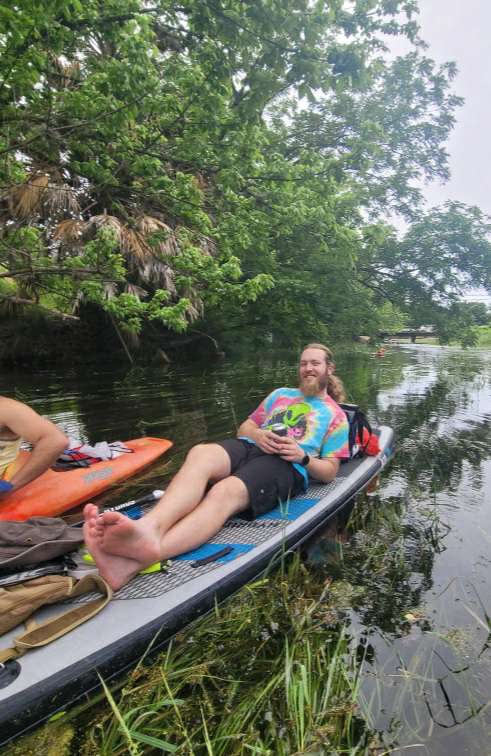
Outside research, I'm usually on the water, on a bike, or behind an instrument.