About
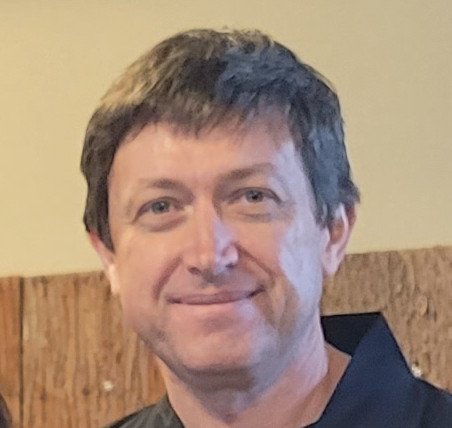
I am an Associate Professor of Computer Science at Texas State University. I received my Ph.D. in Software Engineering from the University of Texas at Austin in 2004 and my M.Sc. in Computer Science from the University of Massachusetts, Amherst in 1997, where I worked in the Multi-Agent Systems Laboratory of Prof. Victor Lesser. I joined Texas State University in 2004. I received a Bachelor of Science in Information and Control Systems from Peter the Great St. Petersburg Polytechnic University, and received formal education in the design of weapons and arms from the Leningrad Military Mechanical Institute (department “E”), with emphasis on ordnance, munitions, and artillery systems.
My research concerns the automated synthesis and analysis of mission-critical software systems and distributed AI. Two threads define my current work: curvature-aware optimization for deep learning — second-order methods built on cubic regularization and Chebyshev spectral analysis that remain feasible at tens-of-millions-of-parameter scale — and formal methods for verification of mission-critical and cyber-physical systems, including runtime verification and, most recently, LLM-assisted program analysis. I also have long-standing expertise in cyber-physical multi-agent systems and software process.
Research
Optimization for Deep Learning
Blockwise adaptive cubic regularization, Chebyshev second-kind spectral preconditioning, and matrix-free Krylov subproblem solvers for scalable second-order optimization, mitigation of spectral bias in implicit neural representations, landscape diagnostics.
Formal Methods & Runtime Verification
Specification and runtime monitoring of mission-critical and cyber-physical systems: efficient and scalable runtime monitors, real-time simulation support for verification, and query-driven assertion frameworks (BraceAssertion) for mobile and sensor systems.
LLM-Assisted Program Analysis
Precise semantic slicing with large language models applied to classical analysis problems, most recently deadlock detection in concurrent Java programs (ICPC 2026, with T. G. Martin and S. Ahmed).
Multi-Agent Systems & Software Process
Coordination and analysis of multi-agent systems, with a contribution to Generalized Partial Global Planning (GPGP/TÆMS) — the domain-independent coordination framework of Victor Lesser's Multi-Agent Systems Laboratory (Lesser et al., JAAMAS 2004), for which I designed and implemented a generalized software architecture for the framework's coordination protocols. Also: multi-agent technology for software process enactment and automated synthesis of software processes for mission-critical settings.
PolyQuantum Intelligence
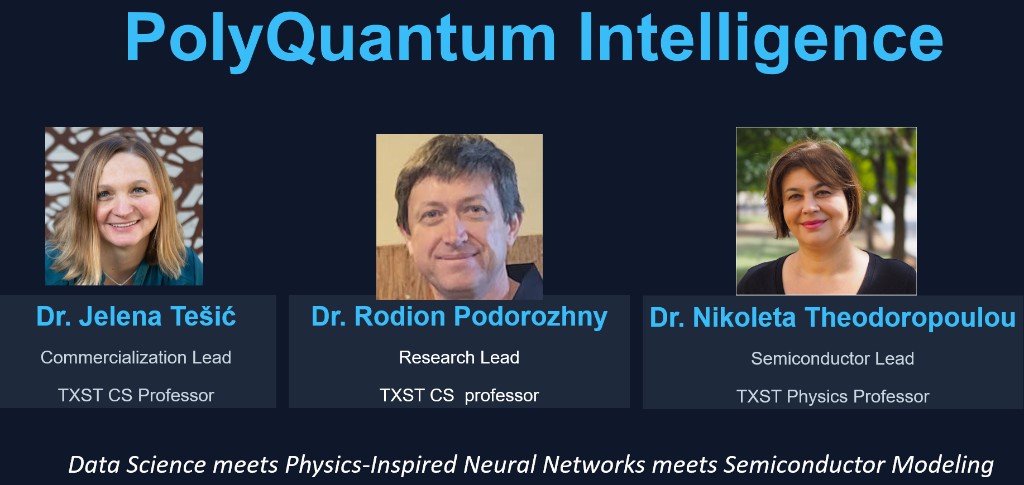
PolyQuantum Intelligence is a cross-disciplinary Texas State initiative combining data science, physics-inspired neural networks, and semiconductor modeling. I serve as Research Lead, with Dr. Jelena Tešić (Commercialization Lead, Computer Science) and Dr. Nikoleta Theodoropoulou (Semiconductor Lead, Physics).
The team was awarded the BobCatalyst Innovation Accelerator Program Award for this research.
Selected Publications & Talks
- Physics-Informed Neural Network Surrogate for Oxygen Vacancy Dynamics in Epitaxial SrTiO3/Si Memristors via Dynamic Spectral Optimization. Under submission to Applied Physics Letters Journal (APL).
- Blockwise Stabilized Adaptive Cubic Regularization with Subsolvers via Recurrence. arXiv:2608.22129, 2026.
- Loss Landscape Features That Make Adam Stall: Definitions, Estimators, and the Preconditioned Hessian View. arXiv:2608.22145, 2026.
- Requirement-Guided Test-Driven Development for Modular Code Generation with Large Language Models. Proc. 34th ACM International Conference on the Foundations of Software Engineering (FSE Companion 2026).
- Precise LLM-Based Semantic Slicing for Deadlock Detection in Concurrent Java Programs. IEEE/ACM ICPC 2026 (Early Research Achievements).
- Curvature-Aware Optimization via Chebyshev Polynomials of the Second Kind for Deep Learning. SIAM Conference on Optimization (OP26), Edinburgh, UK, June 2026 (talk).
- Efficient and Scalable Runtime Monitoring for Cyber-Physical Systems. IEEE Systems Journal, 12(2):1667–1678, 2018.
- Real-Time Simulation Support for Runtime Verification of Cyber-Physical Systems. ACM Transactions on Embedded Computing Systems, 16(4):106:1–106:24, 2017.
- BraceAssertion: Runtime Verification of Cyber-Physical Systems. IEEE MASS 2015, pp. 298–306.
- Evolution of the GPGP/TÆMS Domain-Independent Coordination Framework. Autonomous Agents and Multi-Agent Systems, 9(1–2):87–143, 2004.
Full list: DBLP · DBLP (recent) · TXST faculty profile
Teaching
- CS 3398Software Engineering
- CS 4354Object-Oriented Design and Implementation
- CS 4368Survey of Computer Languages
- CS 4378ZGame Development
- CS 3320Internet Development
- CS 5391Survey of Software Engineering
- CS 5396MSoftware Evolution and Maintenance
- CS 5392Formal Methods in Software Engineering
- CS 5393Software Quality
- CS 5394/4398Advanced Software Engineering Project
- CS 5396Advanced Software Process
News
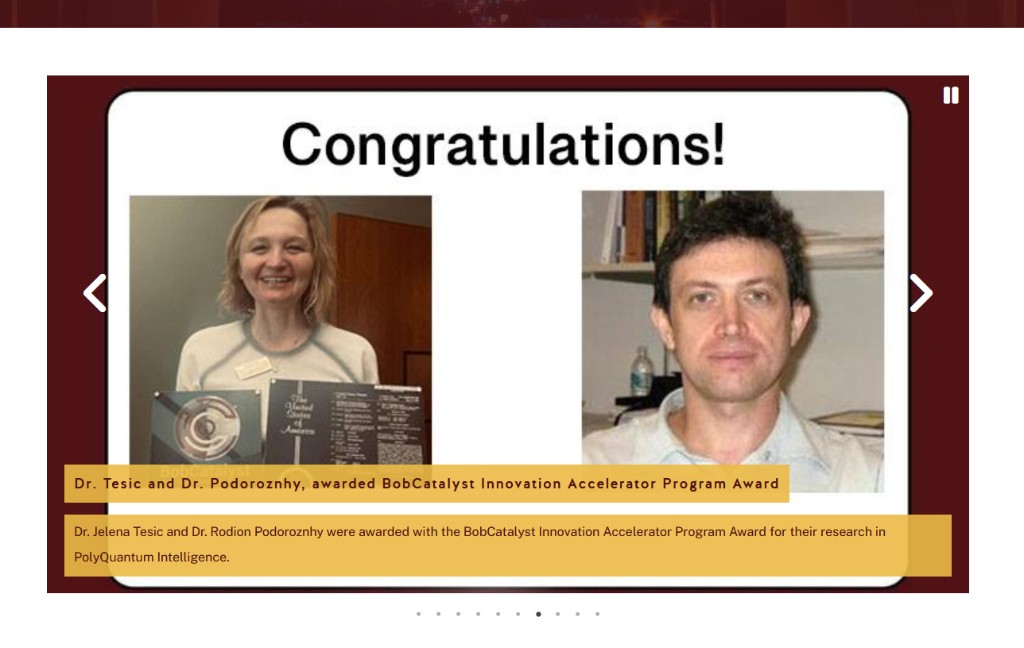
- 2026BobCatalyst Innovation Accelerator Program Award, with Dr. Jelena Tešić, for research in PolyQuantum Intelligence.
- Jun 2026Talk at the SIAM Conference on Optimization (OP26), Edinburgh: “Curvature-Aware Optimization via Chebyshev Polynomials of the Second Kind for Deep Learning.”
- 2026Paper accepted at IEEE/ACM ICPC 2026: LLM-based semantic slicing for deadlock detection in concurrent Java programs.
- 2020Honorary Teaching Award, Texas State University.
Contact
Department
Department of Computer Science
Texas State University
601 University Drive
San Marcos, TX 78666-4616